Poetry & Words, Theology

We were created to know beauty beyond what our senses can take in

IMG_0872

We see it in the burst of green which sprouts up from a thick, decaying layer of broken leaves in the spring. It fills our hearts the way of vase of daffodils fills a room, like a smile brightening every line of the face of the one you love after a long, long absence.

This is beauty.

And mountains and sunsets and the magnetic tide, beautiful songs and lilting poetry, and laughter, clear like bells; these are beauty. These things lift our spirits. They buoy us; they bring happiness. We’re created to see this, to breathe this, to be enveloped in this.

We were created to know beauty beyond what our senses can take in.

And all of this earthly beauty — a fire-tinged sky, the quiet breathing of a sleeping child,  velvet buds on a tangled vine — all this great, overwhelming, everywhere beauty is reflection of the One, the author of good, the divine Creator of all things bright and beautiful.

Poetry & Words, Theology

She’s outside of time. We’re in it.

One week and three days. That’s how long it’s been since Holly left this earth. Thirty years she lived on this side of eternal life.

“We are not alone / We are more than flesh and bone / What is seen will pass away / What is not is going home…” –Andrew Peterson
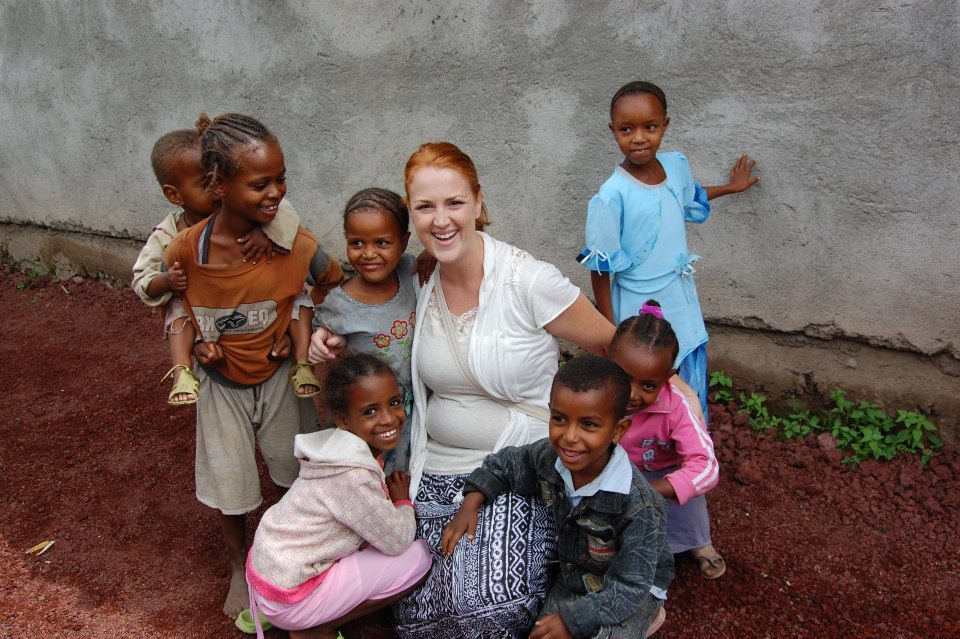
Donations to Ethopian school  Ziway Adami Tulu in memory of Holly Lutterman[Donate in Holly’s memory to the The Ziway + Adami Tulu Project]

And now, she’s home.

She’s dancing in the pure Light, healed. 

She’s outside of time. We’re in it. She’s free, and we’re trapped, feeling deeply the ebb and flow of new grief, constantly aware of life’s frailty.

The thing about death, you know, is that the living keep on living.

“The living can’t quit living,” Wendell Berry writes. “They can’t because they don’t. The light that shines into darkness and never goes out calls them on into life. It calls them back again into the great room. It calls them into their bodies and into the world, into whatever the world will require. It calls them into work and pleasure, goodness and beauty, and the company of other loved ones.”

And so we can’t quit. We don’t. We keep on, changed. Our perspectives shift, our priorities shift, our vision is altered. But we don’t quit.

We mourn, but not without hope. We grieve, but not without hope.

Hope is the anchor.

Hope points me to the “holy shores of uncreated light“, and the One who lights the way.

“‘Praise, Praise!’ I croak. Praise God for all that’s holy, cold, and dark. Praise him for all we lose, for all the river of the years bears off. Praise him for stillness in the wake of pain. Praise him for emptiness. And as you race to spill into the sea, praise him yourself, old Wear. Praise him for dying and the peace of death.

…Now that I can hardly walk, I crawl to meet him there. He takes me in his chilly lap to wash me of my sins. Or I kneel down beside him till within his depths I see a star.

Sometimes this star is still. Sometimes she dances. She is [Holly]’s star. Within that little pool of Wear she winks at me. I wink at her. The secret that we share I cannot tell in full. But this much I will tell. What’s lost is nothing to what’s found, and all the death that ever was, set next to life, would scarcely fill a cup.” -Frederick Buechner

Poetry & Words, Theology

It is early in the days of new grief

The grief will change usIt is early in the days of new grief, and the sorrow comes in waves, tidal, like the roaring surge of surf just before the crash, just before the sea glass scatters, rearranged, just before the shelled critters scurry backwards into the sand.
I lie awake in the stillness, awake until just before the periwinkle dawn. I’m afraid to close my eyes because I don’t want to forget. In the morning, I blink, I sit up, and for eight fleeting, transitory seconds, I’ve forgotten. Then the grief crashes in, then I remember, and the flood of tears roll down.

Maybe the grief will always come like the ocean’s tide, glistening like December topaz, glistening like the salty water that rearranged the Klamath coast every year. The river ran through it, always shifting, always flowing, always shaping the earth around it. Some years the driftwood arranged itself into gentle patterns and the sands fell smooth, sloping down gently into the brackish river. And some years the dunes rose high, and the winds whipped, and the gnarled branches of petrified wood were tangled in between the constant rise and fall of frothy waves.

Like the river against the stones, the ocean against the glass, and the mouth of the ocean against the changing shore, the grief will change me.

It will change us.

Every year, it will look different.

The river will continue to ebb and flow, the shoreline will be carved and smoothed, the waters will rise and fall, the glass will be broken and polished, the winds will breathe in and out.

He makes all things beautiful in His time.

Little Style, Poetry & Words

LITTLE STYLE :: When it comes to LEGO® bricks, pink is just another color

Modern legos for girls

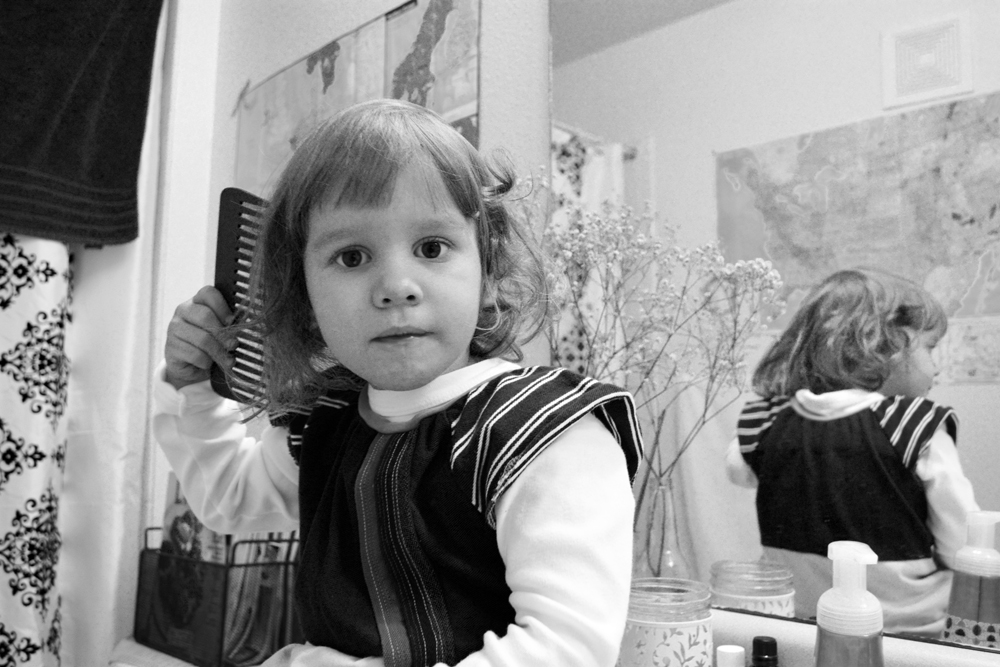
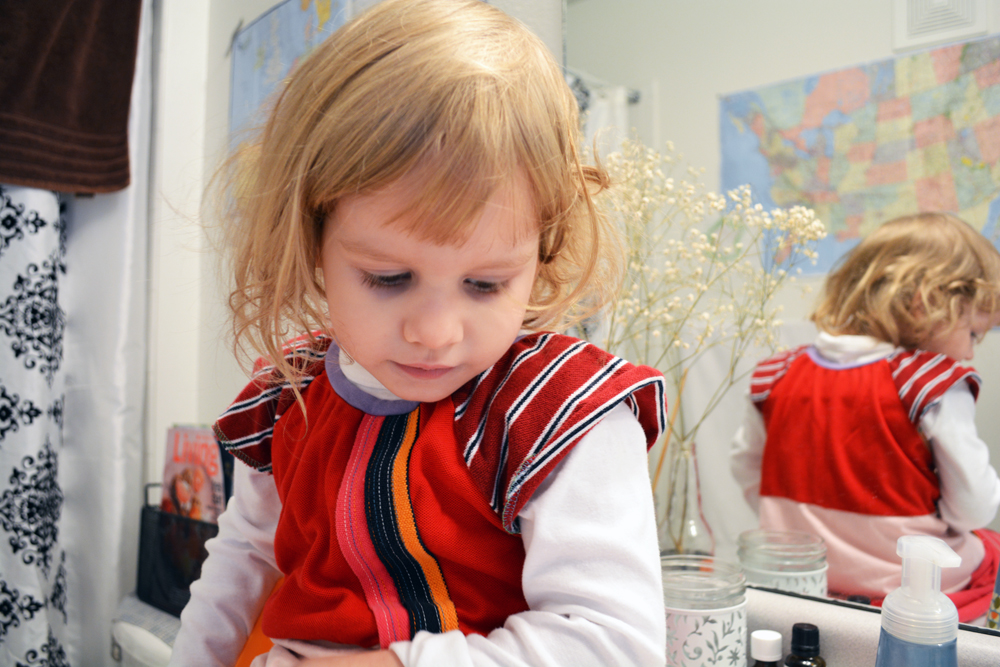
This is my daughter. That is her LEGO collection.

You may notice a light smattering of pink.

Ah, pink. Nothing gets bloggers’ undies in a bunch faster than the mention of pink LEGO bricks. I might even lose my blogger card.

Can you imagine the kerfuffle in 1962 when LEGO introduced motors? The audacity! The nerve! The beginning of the end of children’s creativity!

Thankfully, there were no bloggers in 1962.

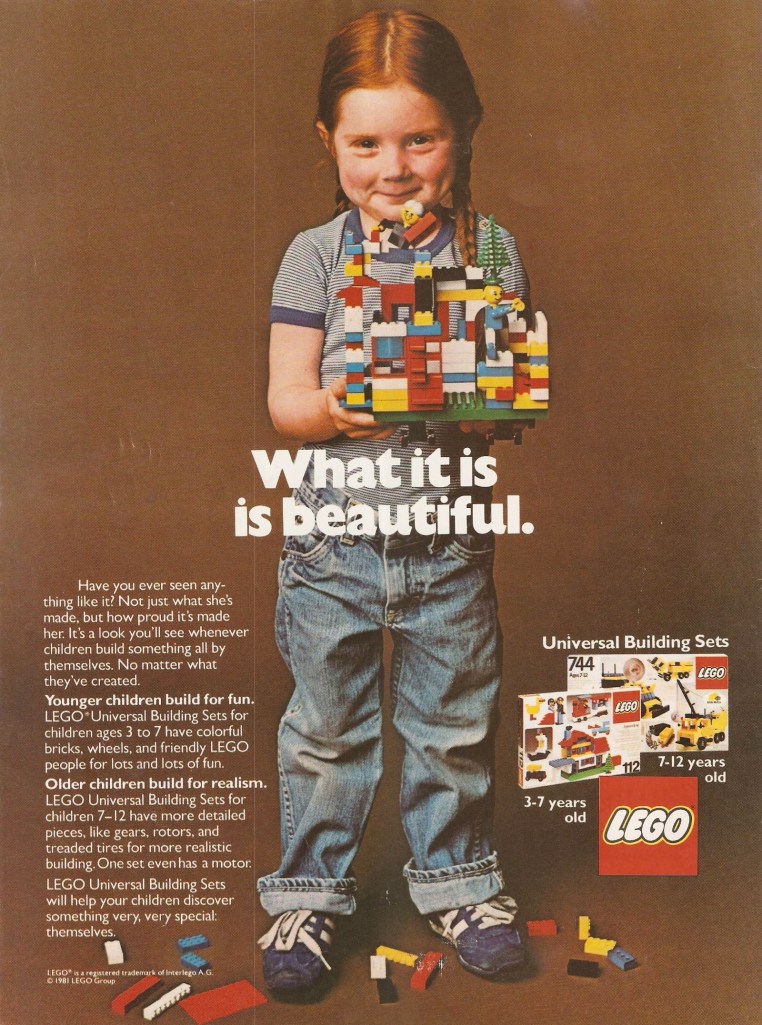
So, let’s skip forward a bit and start where most of the LEGO diatribes begin: the now infamous 1981 LEGO ad. It’s completely endearing and delightful! And it advertised universal building sets. The universal building sets were awesome.

LEGO 1981 ad

But pink bricks alone hardly will destroy a girl’s — or boy’s for that matter — childhood.

Pink is just a color.

By vilifying pink LEGO sets, we give a color (a color!) far more power than it ever should have. When we gasp at pink bricks, we’re saying the toy is more powerful than the imagination of the child playing with it.

Let’s chill out. It’s just pink. And besides, this color isn’t the worst thing Lego is introducing to our children. I present to you . . . The Simpsons in LEGO form, coming February 2014.

So, let it go. Shake your pinkophobia out.

In a few more days we’ll all have something else to blog out.

New Legos are not harming little girls. Pink is just a color

Poetry & Words, Theology

The thing about life is how fragile it is

The thing about life is how fragile it is

The thing about life is how fragile it is.

We don’t realize it.

We’re too busy pumping up humanity and climbing Everest and launching ourselves into orbit. We collect accolades and list our achievements and add antennas atop towers in an effort to make it all seem bigger, better, taller than it is. We love the stories that are larger than our collective humanity, the people who muster brute strength to do the one thing that no one else can even imagine.

We’re obsessed with strength.

We’re fascinated by human success. We can form armies, we can stop rivers. We’re so busy being strong, we sometimes forget that for all our sky-high buildings and conquered Everests and technological masterpieces, we can’t stop a cell from marching.

We can’t push oxygen where it needs to go. We’re no life-givers.

And in these moments when our frailty becomes the largest thing in the room, we see. We see the veil, thinner than we ever knew it could be. We see the Milky Way and we see the oceans and we see our souls and we see the sky as a canopy over us.

And the wind rushes in, and the curtain lifts up for one ethereal moment and then falls — and we gain a glimpse, and know that in all our trembling bravery and brawn, it was always His hand holding us up.

And we cling to that.

Adoption, Poetry & Words, Theology

The Hague Convention is not Enough

If you’re friends with me on my personal Facebook account, I know, I’m sorry. I’ve been over all this before. But when I saw the positive reaction online to the news this morning — Japan just became the 91st country to ratify the Hague Convention — I’ve decided I need to talk about it here, too.

Because it matters.

I’m not going to talk about whether or not there were good intentions behind the Hague Convention in the beginning. I’m going to talk about now.

We’ve seen it over and over and over again: the Convention adds an unnecessary layer of bureaucracy and red tape to the countries which ratify the treaty. It piles on the list of requirements, and in many cases the countries don’t have the infrastructure, the funding or the ability to comply with the new regulations. And in the wake of the Hague Convention — not always, but often — international adoptions grind to a near-halt.

Take a look at the Hague Convention’s complicated legacy in Guatemala.


I don’t have the answers, but I know there’s more to international child advocacy than the Hague Convention.  It’s not enough to push a nation to ratify, and then walk away.

If you want to take a more in-depth look at the way the international adoption system is broken, I’d highly recommend watching the STUCK documentary.  (At the time of this post, you can stream STUCK for free if you have a Netflix account. If you don’t have a way to access Netflix, email me, and I can send you a different link to stream the film.)

Inspiration, Life in Photos

INSPIRATION :: Inside The Kinfolk Table

Inside 'The Kinfolk Table' on the Oaxacaborn blog

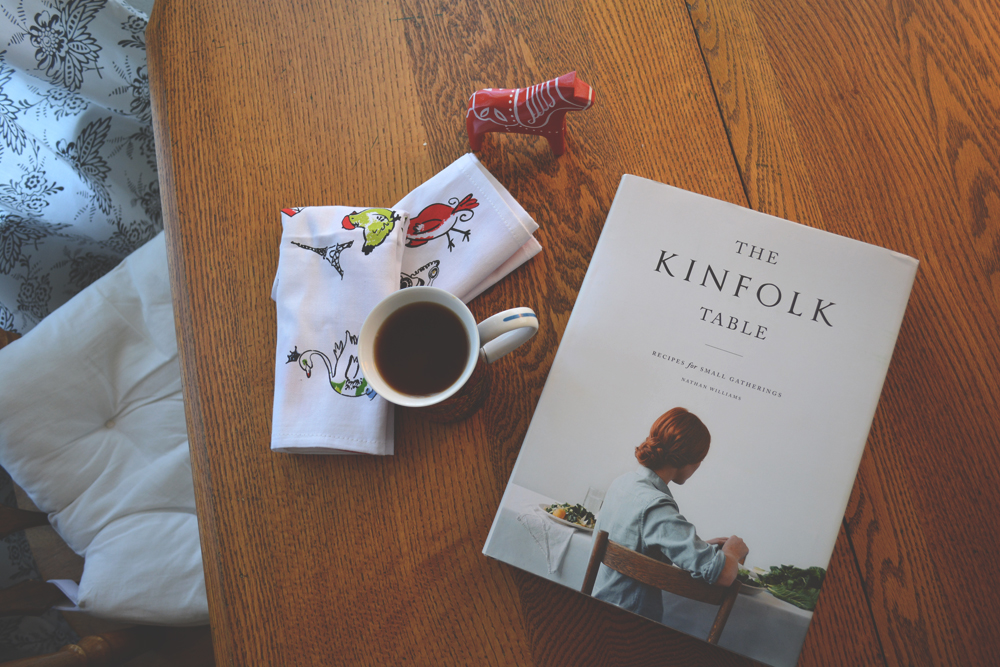
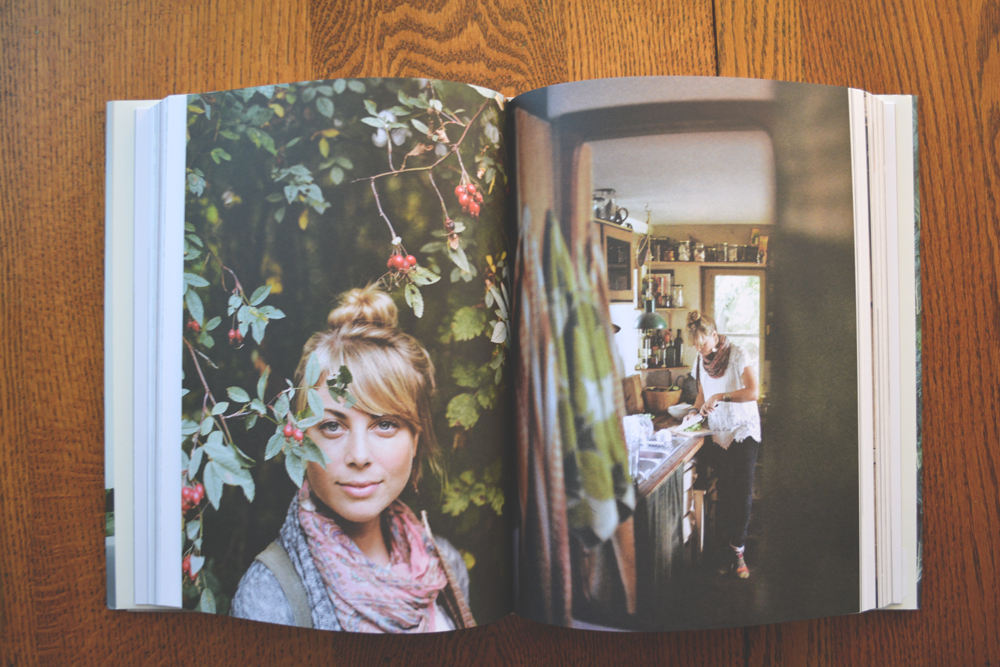
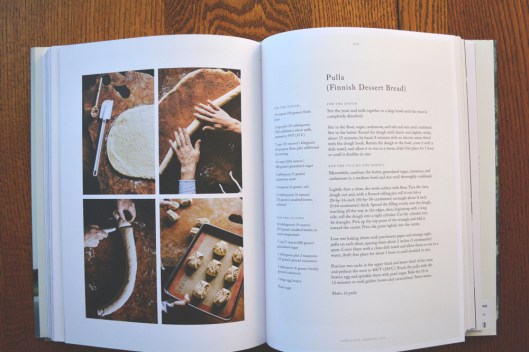
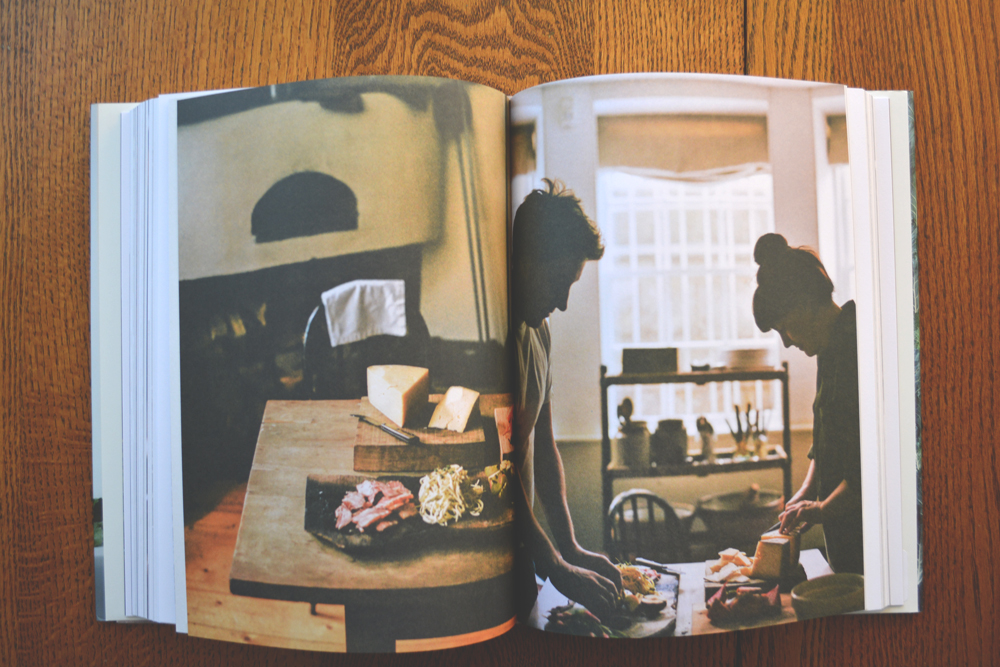
It’s a cookbook, yes; but more than that, it’s a story of people. It’s a story of homes from Brooklyn to Copenhagen to Portland, where people linger, laughing, over favorite meals. The Kinfolk Table is a song to warm kitchens everywhere, where the food is exquisite, where you are wholly present, and no one notices if the Christmas napkins are still in rotation (mine are). 

Inside 'The Kinfolk Table' on the Oaxacaborn blog

Inside 'The Kinfolk Table' on the Oaxacaborn blog

Inside 'The Kinfolk Table' on the Oaxacaborn blog

Inside 'The Kinfolk Table' on the Oaxacaborn blog

Inside 'The Kinfolk Table' on the Oaxacaborn blog

6 - Inside the Kinfolk Table

So, pause. Make this the year you live intentionally. Take an extra half an hour to make your favorite biscuit recipe. And then when they’re still warm, pull a book off the shelf, sit down, and breathe.

Inside 'The Kinfolk Table' on the Oaxacaborn blog

You might not have time for this.

In the end, you might have a flour-covered three-year-old, crumbs all over your shirt,  a sink full of dishes, unanswered emails, and clothes waiting in the dryer (not pictured).

But I’ll let you decide if it was worth it.